









Subway Surfers
Subway Surfers is a fast-paced endless runner where you dodge trains, switch lanes, collect coins, and use power-ups to stretch every run. Quick reac…
Played 721 times
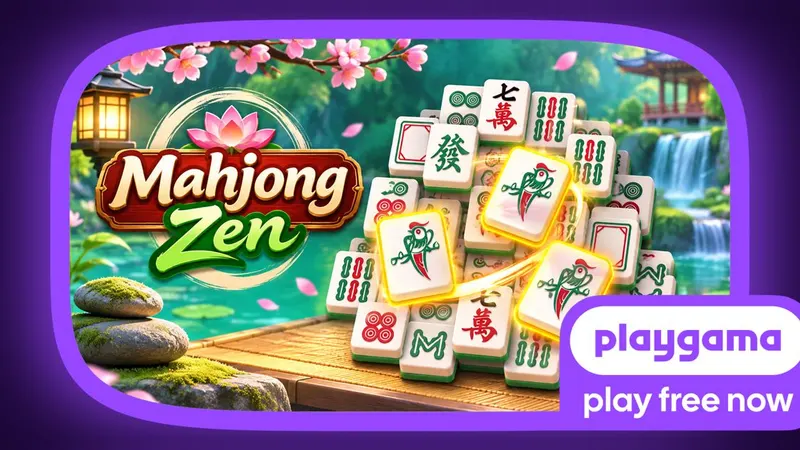
Strip away the tiles and what is left is a game about what sits on top of what: free an edge, pair the faces, repeat until the board is gone.
Looking for more options after Mahjong Zen? Visit All Games to browse the full library, or use the contact page if you want to report a bug or ask for support.
A mahjong board looks like a memory test. It is a test about edges — dozens of tiles can be face up at once and only a handful of them are legally removable at any moment.
Two conditions decide whether a tile can leave the board: nothing may be lying on top of it, and at least one of its sides must be clear, left or right. A tile three layers deep is inert no matter how many twins you can see underneath it, and the tile sitting in the middle of a wide row is just as stuck, because both of its neighbours block it.
That second condition is the one people miss. Stacks are obvious; a flat row is not, and a board can look completely open while half its tiles have no free edge at all.
Both halves of a match have to be legally selectable on their own. A free tile whose twin is buried is not a pair, it is a key you have to earn first — which reorders the board. The useful question is never "where are the two matching faces" but "which removal opens the most new edges", because that is the move that turns one legal pair into three.
Selection is a tap on the first tile and a tap on its twin. There is no dragging, no rotation and no clock: the board is meant to be read at whatever pace suits you, which is why the layout runs in portrait as happily as in landscape on a phone. Removing a pair clears both tiles and frees whatever they were covering, and the board is finished only when the last pair goes.
Opening boards are wide, shallow and forgiving. Later ones stack tiles onto tiles and fold them into shapes that leave only a few edges exposed at a time. Nothing in the rulebook changes between an easy board and a hard one — the geometry does all of the work, so the habit to build early is scanning for the tallest stack rather than the most obvious pair.
Two conditions together: no tile resting on top of it, and at least one clear side to its left or its right. Failing either one leaves it on the board regardless of whether its twin is free.
Yes. A selectable tile whose match is buried in the middle of the layout is not a pair yet - the buried half has to be uncovered first, which is what reorders a board.
No clock is part of the design; the boards are built to be read at your own pace, which is also why the layout works in portrait on a phone as well as in landscape.
By removing every tile, in pairs, until none are left. There is no score to chase and no partial credit - the board is either cleared or it is not.
The rules never change; the layouts do. Early boards are wide and shallow, later ones stack tiles and fold them into shapes that leave only a few free edges at a time.
Calm boards with one uncompromising rule underneath them.
Subway Surfers is a fast-paced endless runner where you dodge trains, switch lanes, collect coins, and use power-ups to stretch every run. Quick reac…
Temple Run 2 is an endless runner where you escape with a stolen idol, dodge traps, leap across gaps, and collect coins on dangerous temple paths. Fa…
100 Meters Race is a fast sprint game where rhythm, acceleration, and energy management decide who wins the track. Alternate your inputs quickly, hol…
G-Switch 4 is a high-speed gravity runner where one button flips your character between floor and ceiling. Perfect timing, quick reactions, and clean…
Smash Karts is a multiplayer kart battle game where you drive, collect weapon boxes, and fight other players in short arena matches. Fast movement, s…